The short answer
Choose the builder who can show you exactly what their price includes, who set their allowances at what materials actually cost here, and who describes their process the same way in month eight as they did in the first meeting. Everything else on this page is a way of testing those three things. Price matters, but on a nine to fourteen month build the price you were quoted and the price you pay are two different numbers, and the distance between them is decided by scope discipline.
This page also says plainly where a production builder is the better answer and where our own design-build model is a poor fit, because a guide that recommends us in every scenario would not be worth reading.
What actually separates one builder from another
Four things separate builders in practice: scope discipline, allowance honesty, communication cadence, and the strength of their subcontractor relationships. None of those appear in marketing, because every builder in the Treasure Valley claims quality, craftsmanship and communication in almost identical words, and claims that cost nothing to make carry no information.
Scope discipline is whether the proposal describes the whole house or only the parts that were easy to price. A builder with it hands you a document where you can find the driveway, the final grade, the utility connections and the window coverings, each one priced, allowanced, or explicitly excluded. A builder without it hands you a shorter document that feels cleaner and costs more later.
Allowance honesty is whether the placeholder numbers for flooring, cabinetry, countertops and fixtures reflect what those things cost at Boise suppliers, or whether they were chosen to make the total attractive. Communication cadence is whether updates are scheduled or requested, and a weekly written update that arrives on a bad week as well as a good one changes a year-long project more than almost anything else. Subcontractor relationships decide whether the framer shows up in the week you were promised or the week after the builder who pays faster gets served.
Production, semi-custom, and full custom
There are three residential delivery models in this market, and choosing the wrong one is a more expensive mistake than choosing the wrong company inside the right one. They are not tiers of quality but different products for different situations.
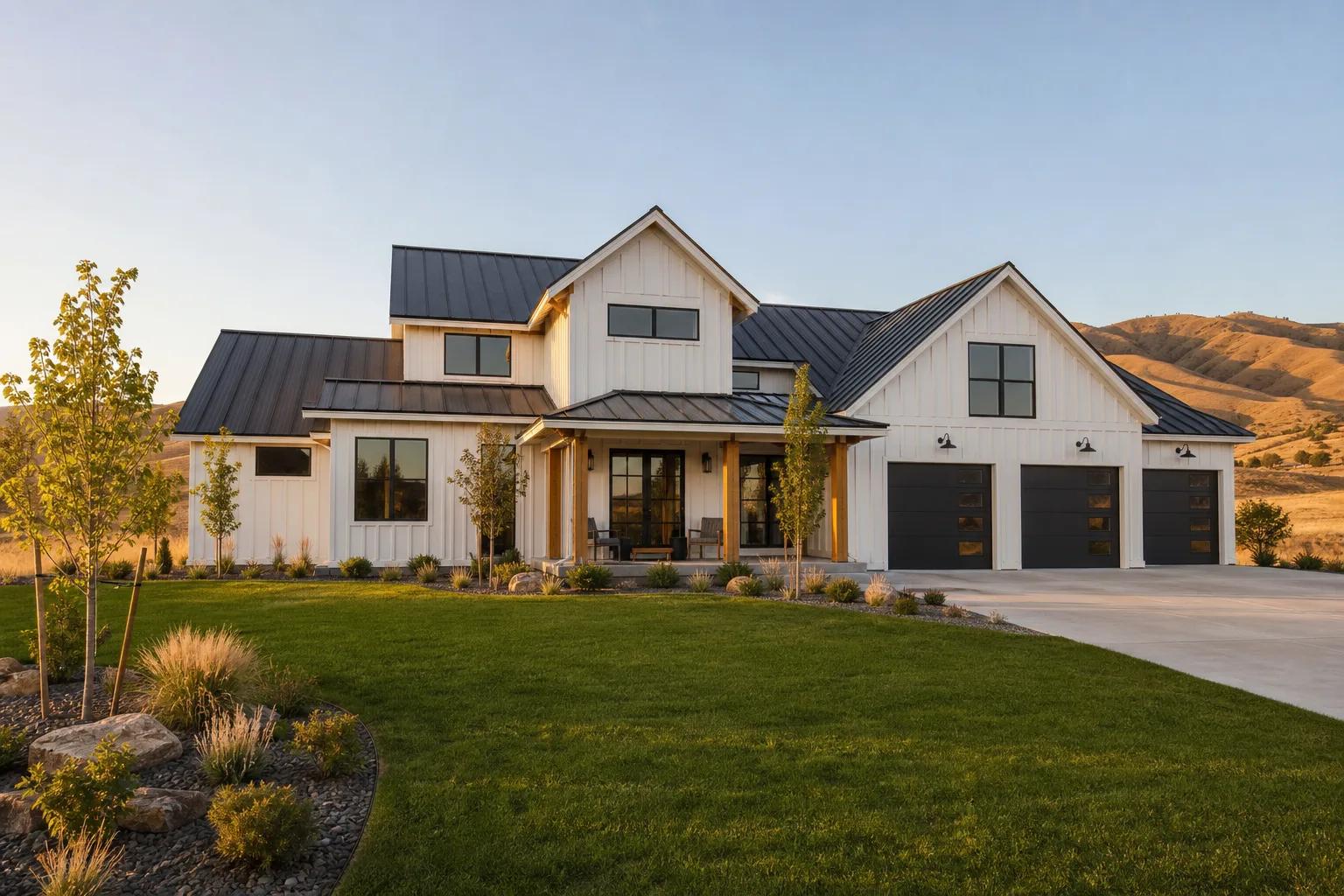
A production builder builds a set catalogue of plans, usually in subdivisions they or a developer control, with a defined options list. The process is fast and the price is firm because the plan has been built many times before. What you give up is plan freedom, finish freedom, and often the choice of lot.
A semi-custom builder starts from a plan library and modifies it, commonly $225 to $300 per finished square foot excluding land, or roughly $450,000 to $600,000 for a 2,000 square foot house. A full custom builder starts from your site and your requirements instead of a plan, commonly $250 to $400 per finished square foot excluding land, so a 2,400 square foot house typically lands between $600,000 and $960,000. A simple single-level plan on a flat valley lot can come in near $225 per square foot, while a foothills site with steep grade and high detail regularly runs above $450 per square foot.
| Production | Semi-custom | Full custom | |
|---|---|---|---|
| Starting point | Fixed plan catalogue | Plan library, modified | Your site and brief |
| Cost per finished sq ft | Base plus options | $225 to $300 | $250 to $400 |
| Lot | Usually theirs | Theirs or yours | Usually yours |
| Design cost | In the base price | Modest | 5 to 12 percent of construction |
| Best for | Proven plan, firm price | Some control, contained cost | Unusual site or requirements |
If a production builder's plan already fits how you live, buying it is not a compromise. You will pay less and finish sooner than you would with us. The comparison is worked through in production builder versus custom builder, and our middle option is on the semi-custom homes page.
Design-build or an architect and a general contractor
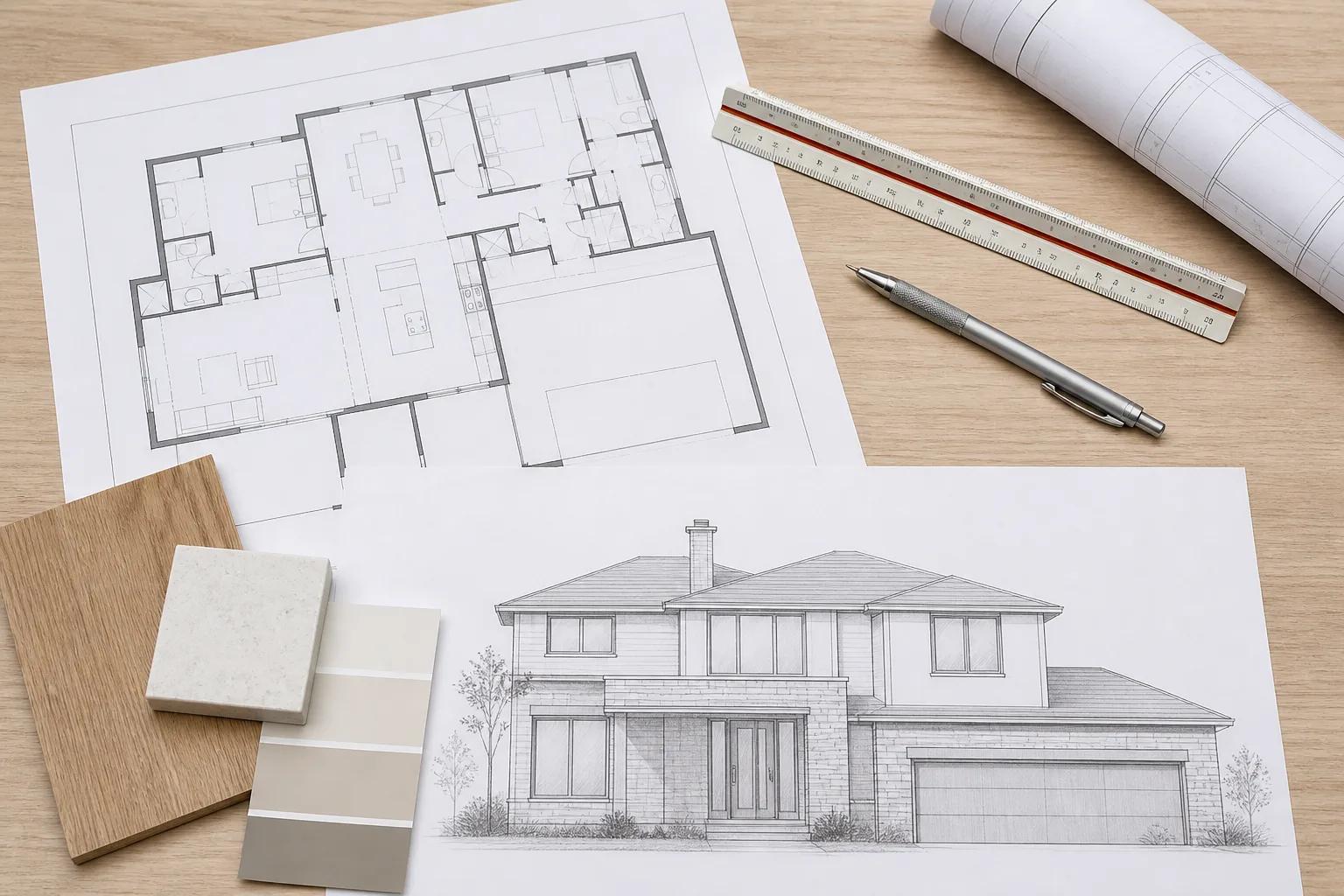
Design-build puts design and construction under one contract so that pricing happens during design; hiring an architect and a general contractor separately gives you an independent designer and a competitive bid on finished drawings. Both are legitimate, and the way each one fails is what you should be choosing between.
Under design-build, the company that will build the house is costing it while it is still on paper. A wall gets moved when moving it is free, and there is no gap between the drawings being finished and the construction being priced. It also means one phone number when something goes wrong, and nobody in a position to say the problem belongs to the other party.
Under the separate route, you hire an architect whose only client is you. They carry no construction risk, so they have no financial reason to steer you toward what is easy to build. You get a complete set of drawings, send them to three builders, and get three prices for the same thing, which is the cleanest comparison available in residential construction. The cost is time, a design fee fully separate from construction, and the risk that the drawings come back over budget after you have paid for them. The two models are compared line by line in design-build versus general contractor, and our own reasoning is on the design-build page.
Where design-build is genuinely the wrong choice
Design-build is worse than hiring separately whenever independence matters more to you than speed. This is the part most design-build companies leave out, so here it is plainly.
The first case is when you want an independent check on price. Under design-build, the company designing the house is also the company telling you what that design costs, and nobody in the room has the job of testing that number. You can push back by asking to see the quotes behind the major lines, but the conflict is structural and you should not let anyone tell you otherwise.
The second is when the architecture is the point. Design-build companies design well within what they build well, and that boundary exists even when nobody names it. The third is when you want the drawings competitively bid, which design-build removes by definition.
The fourth is fit. Every design-build company has a house it builds naturally and a house it builds against the grain. Ours is a site-driven custom or semi-custom home in Ada or Canyon County. If you want a plan that has been built forty times before at a production price, or a highly unusual architectural statement, we are not the efficient answer and we will say so in the first meeting rather than the fourth.
How Idaho regulates residential contractors
Idaho registers residential contractors rather than licensing them, which means the word "licensed" does not mean what most homeowners assume it means. Registration confirms that a contractor filed with the state and carries the required insurance and bond. It does not involve an examination of construction knowledge, a review of completed projects, or an assessment of financial stability.
That matters twice over. The verification work a licensing board would do elsewhere falls to you, because a registration number tells you a company exists and filed paperwork, not whether it can build your house. It should also make you alert to how builders describe themselves. We say bonded and insured, with Idaho contractor registration available on request, because that is accurate. A company advertising itself as a licensed home builder in Idaho is either being loose with language or hoping you do not know the difference.
Ask for the registration number in writing, verify it against the state record yourself rather than accepting a screenshot, and confirm the name on the registration matches the name on the contract you are being asked to sign. The individual trades are a separate matter: the people doing electrical, plumbing and mechanical work carry their own state credentials, which do not transfer to the general contractor's registration.
Verifying bonding and insurance, and what to ask the insurer
Ask for a certificate of insurance sent directly from the agent rather than forwarded by the builder, then call the agent listed on it. A certificate is a snapshot of a moment, and it is trivially easy to produce a document that was accurate in January and is not accurate now.
Ask the agent four things: whether the policy is currently in force, whether any cancellation or non-renewal is pending, whether the coverage extends to residential new construction rather than only to light commercial or service work, and whether there are exclusions that would matter on your project. That last one is where the useful answers live, because a policy can exclude subcontracted work or carry a residential construction exclusion that makes the certificate close to meaningless for a house.
You want general liability and workers compensation at minimum. Workers compensation is the one homeowners skip and should not, because an uninsured injury on your lot can find its way to you. Ask whether the trades carry their own coverage and how the builder keeps it verified through a year-long build, because collecting certificates once at the start and never again is a gap. Then settle builder's risk, which covers the structure during construction against fire, theft and weather: who buys it, what the deductible is, and who pays it.
Be honest with yourself about the bond. A contractor registration bond is a small instrument with a narrow purpose, and it is not a guarantee that your house gets finished. A performance bond does secure completion, but it is uncommon on residential custom homes. If someone implies their bond protects your deposit, ask them to point at the language.
Reading a bid, and why the exclusions page matters most
Read the exclusions page before the price page, because that is where the real scope lives. Legitimate exclusions are normal: land, the well and septic on a rural parcel, impact and utility connection fees, appliances, window coverings, and landscape beyond a basic package. What you are looking for is an exclusion that contradicts something said in the sales meeting, and a list that is suspiciously short for the complexity of the project. A bid on a sloped foothills lot with three exclusions has not thought about the site, and that missing thought arrives later as a change order rather than as a discount. Two items vanish more often than any others: the finished driveway with final grade, and impact and utility connection fees, which differ across Boise, Meridian, Eagle, Nampa and the rest of Ada and Canyon County.
Site work is the largest swing between two bids. It commonly runs $25,000 to $50,000 on a serviced subdivision lot, and $80,000 to $150,000 on a rural parcel needing a well, a septic system permitted through Central District Health, and an access drive. Design and engineering is the second largest at 5 to 12 percent of construction cost, roughly $9,000 to $35,000, and it sits inside some proposals and outside others. The method for putting proposals on the same footing is in how to compare home builder bids, and the underlying causes are in why home building bids vary so much. If nobody has walked the lot, nobody has priced the lot, which is what a written lot evaluation at $950 to $3,500 is for.
How allowances are used to win bids
An allowance set below what the material actually costs is the most effective way to win a bid without lying, and it is why two honest-looking proposals can differ by tens of thousands of dollars. An allowance is a placeholder figure for something you have not selected yet: flooring, cabinetry, countertops, tile, lighting, plumbing fixtures, hardware, appliances, landscape.
A whole house carries dozens of them and each one runs for months. If a builder sets the cabinetry allowance at a number no cabinet shop in the valley would quote, the total drops, the builder wins the job, and you find the gap in month six when every door you like is above the line. Nothing dishonest was written down. The number was optimistic, and you paid for the optimism.
The test is not what the allowance is, it is how it was derived. Ask any builder to show you the quote behind one allowance line, chosen by you rather than by them. A builder who set it properly answers in about four seconds and forwards the quote. A builder who did not will explain the concept of allowances to you instead, which is the answer. We set allowances at what things cost at Boise suppliers rather than at a number that makes the total attractive, which occasionally makes our proposal look expensive next to one that did the opposite. The bands in our Boise home building cost guide are a useful check while you do this.
Fixed price, cost plus, and the guaranteed maximum
A fixed price puts the risk of an overrun on the builder, cost plus puts it on you and shows you every invoice, and a guaranteed maximum price does both. Over nine to fourteen months this is the central financial decision you make, because a long build gives every uncertainty room to develop.
A fixed price is fixed against the drawings, the specification and the allowance schedule attached to the contract, not against the house you eventually want. The builder prices a contingency for the risk they are carrying, and you pay for it whether or not it is used. For most people building a family home with a construction loan, that is a fair price for a number they can plan around.
Cost plus bills actual costs plus a stated fee. Ask whether the fee is a fixed amount or a percentage, because a percentage fee means every dollar of overrun increases the builder's income. A guaranteed maximum price bills like cost plus and caps like a fixed price, and on a custom home it is often the most honest structure available, provided the design is developed enough for the cap to be set responsibly. A ceiling produced from schematic drawings is a guess wearing a guarantee's clothes. The full comparison, including how draws behave under each and what an escalation clause should say, is in fixed price versus cost plus.
Who is actually on your site, and who works for them
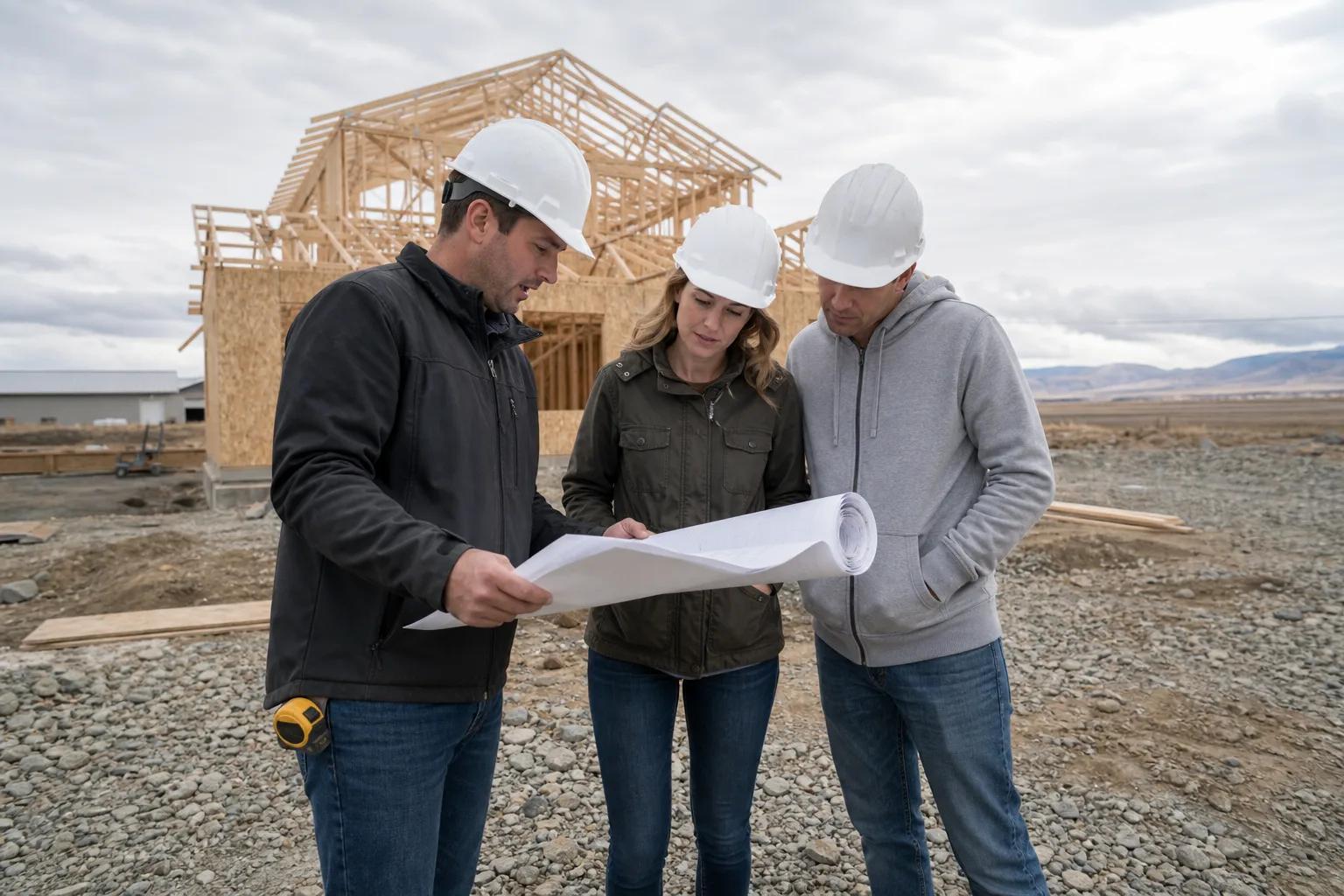
Ask how many homes the superintendent assigned to your project is running at the same time, and treat the answer as one of the most predictive numbers in the whole selection process. A superintendent running three houses can be on each one daily. A superintendent running nine is a scheduler with a truck, and the difference shows up as trades arriving before the previous trade finished, work that has to be redone, and questions that wait a week for an answer.
Ask who that person is by name, whether they will change during your build, and who you contact when they are unreachable. Then ask about the trades. Most Treasure Valley builders subcontract nearly everything, which is normal. What matters is whether the same framer, plumber, electrician and finish carpenter have worked with this builder for years, and whether they get paid on time. Trade partners give their best crews to the builders who pay reliably and schedule realistically.
Finally, ask what the written communication rhythm is. We send a written progress update every week, including the weeks where the news is that nothing moved because a plan review was outstanding. The weeks with nothing to report are the ones where most builders go quiet, and going quiet is what turns a normal delay into a crisis. The sequence of what should be happening when is in our Boise home building process guide.
The questions that reveal something, and the ones that do not
Any question a builder can answer well by simply being reasonable is a wasted question; the useful ones require them to produce a document, a name, or an uncomfortable story. Asking how they handle communication gets the same answer from everybody. Asking them to send last week's update from their most recent project with the names removed does not.
Four questions do most of the work. Who is on my site daily and how many other homes are they running. Show me the quote behind this specific allowance line. What was the last change order you issued on another project, what caused it, and how was it presented to the owner. And what went wrong on your last build. That fourth one is the important one, and the tell is not the story itself but whether they have one ready and whether they describe their own part in it.
Two more are worth adding. Ask what happens to unused contingency at closeout, because the answer separates builders quickly. And ask what would make them decline this project, because a builder who has never turned down work is not paying attention to fit. The longer list is in questions to ask a home builder before you sign.
Red flags worth walking away from
The warning signs that matter are about process and paperwork, not personality. A builder can be likeable and still run a project badly, and a blunt one can run it beautifully, so judge the documents.
A large deposit demanded before a contract exists is the clearest signal, particularly when it is framed as holding a spot in the schedule. Pressure to sign quickly, or a bid with a short expiry and no willingness to extend it, tells you how the build will feel; a builder who will not give you two weeks to understand a $700,000 decision has already answered several of your questions. A proposal with no exclusions list, or a refusal to put in writing an answer that was given happily in conversation, is the same signal in another form.
Others to weigh: no written change order process, or one that lets work proceed before you approve it. References who all completed years ago. A company describing itself as licensed in a state that registers contractors. And a price dramatically below the others, which almost always means the proposal carries less rather than that the builder is more efficient. Each of these is examined in home builder red flags.
How to check references properly
Ask for three references: a recent completion, a build finished at least two years ago, and one that went badly. Most homeowners call the list they are given, hear that everyone was lovely, and learn nothing, because a reference list is a curated marketing asset and the builder knows exactly who is on it.
The two-year-old reference is where warranty behaviour lives. A builder is attentive during construction because you still hold the remaining draws. What happens in month fourteen, when the money is spent and a door has dropped, is the part you cannot observe from a recent project. Ask that owner what they reported, how long the response took, and whether it was fixed or argued about.
The difficult reference is the most valuable request you will make. Every builder has a project that went sideways, because houses are complicated and a year is a long time. Ask directly for the name of a client whose build did not go well. A builder who gives you that name is telling you they handled it and can stand behind how they handled it. A builder who says it has never happened is either new or is not being straight with you.
On the call, ask what surprised them about the cost, how many change orders there were and who initiated them, whether the schedule held, and what they would do differently next time.
What a good contract contains
A fair residential construction contract defines the scope, the money, the changes, the finish line and the warranty, and if any of those five is vague the others will not save you. Read it before you read the brochure, and be willing to ask for changes.
Scope means drawings and specifications attached as exhibits, a complete allowance schedule, and a written exclusions list. Money means a published draw schedule tied to verifiable milestones such as foundation, framing, dry-in, mechanical rough-in, drywall and completion, with lien waivers required from subcontractors and suppliers at each draw. That last point protects you from paying the builder for work whose supplier was never paid.
Changes mean a written change order process in which nothing proceeds until you have signed, with the price and the schedule impact both stated. A change order that prices the work and stays silent on the days it adds is half a change order. Escalation language should say what happens if material costs move, and it should be reciprocal so decreases come back to you.
The finish line has to be defined. Substantial completion should be written down as a specific condition, normally the point at which the house is usable and a certificate of occupancy has been issued, with a punch list, a deadline for completing it, and an amount retained until it is done. Without it, the argument at the end of the project has no reference point. Warranty means a stated term, scope and process. We provide a one-year workmanship warranty after possession, and the useful question for any builder is not the length but who answers the phone and how fast. Last, know before you sign whether the dispute clause commits you to mediation, arbitration or litigation.
How to make the final decision
Once the bids are normalized and the references are checked, choose on scope discipline and supervision rather than on the remaining price difference. A properly normalized comparison usually collapses a six-figure gap into a few thousand dollars, and a few thousand dollars across a nine to fourteen month project is not a reason to pick anyone.
Rank the finalists on four things. Whose proposal did you understand without asking three follow-up questions. Whose allowances traced back to real quotes. Whose superintendent is running the fewest houses. And whose difficult reference told the same story the builder told you. If one company wins three of those four, that is your answer even if they are not the cheapest.
Weigh fit honestly at the same time. If the plan you love is in a production builder's catalogue, buy it from them. If the architecture is the point, hire an architect and bid the drawings. If you have a complicated lot in the Boise foothills, an acreage parcel outside Star or Middleton, or requirements no existing plan handles, a design-build custom or semi-custom process will serve you better. Building in Boise, Meridian, Eagle or Nampa also carries different permitting realities depending on whether the parcel sits in Ada or Canyon County.
Where to start
Get a cost range before you get attached to a plan, then test one real proposal against the checks on this page. Run a size and finish level through the build cost calculator to see the band your project sits in, then read how we work on the custom home builder page. If you already have proposals in hand, we will read a competing bid with you and tell you what it is missing, including when the answer is that the other builder has priced it fairly.
We are a design-build home builder serving Boise, Meridian, Eagle, Nampa, Kuna, Star, Middleton and Caldwell. We are bonded and insured, and our Idaho contractor registration is available on request. We handle permits, plan review, engineering and utility applications in-house for Ada and Canyon County, we publish our draw schedule, we set allowances at what things actually cost here, and we send a written update every week. If that is how you want to build, send us your lot and your plan and we will tell you honestly whether we are the right fit.